

Top Oz Tours offers a great range of Spain tours and experiences. You can browse the options here.
Tapas, paella, gazpacho, churros, tortillas, croquetas, jamón, and chorizo are Spanish dishes and ingredients that you’ll see on many a menu across the globe.
However, Spanish cuisine ascends to a whole new level when enjoyed in Spain itself. The country’s dining scene is undoubtedly one of the best in the world and offers a fabulous fusion of fresh ingredients and characterful spices. Add to that, the influence of different cultures throughout the centuries, including the Moors, and you have a culinary variant that is rich and rewarding.
If you’re lucky enough to be visiting this incredible country, pack your appetite! That said, it’s also worth equipping yourself with a basic understanding of the principles of Spanish dining, to ensure you get the most from your visit. Make sure you spend some time researching the culinary traditions of the area you’re travelling to. While Spain is not a massive country, there are significant differences among the regions in terms of culture, language, and food. But you’ll always find meals filled with flavour and seasoned with an interesting backstory.

One thing to bear in mind is that serving sizes in Spain tend to be quite generous. If you’re not sure whether a particular dish is for you, ask for a small serving or one dish to share between two people.
Here are some of the best dishes to try in Spain, and some tips for how to order them in Spanish! If you’re interested in taking your language skills beyond the basics, we have some tips for that too. Vamos!
Savour the succulent seafood
With close to 5,000 kilometres of coastline, it will come as no surprise to learn that seafood is one of the mainstays of the Spanish diet. Bookended by the North Atlantic Ocean and Mediterranean Sea, fishing is still one of the country’s key economic activities. Try the popular fish dish known as bacalao — dried and salted cod, which is mainly served in Basque Country in northern Spain. It often comes with a sauce called pil-pil — a mix of olive oil, garlic, and chilli. Mussels and calamari are also very popular across the country.

Pass the paella, please
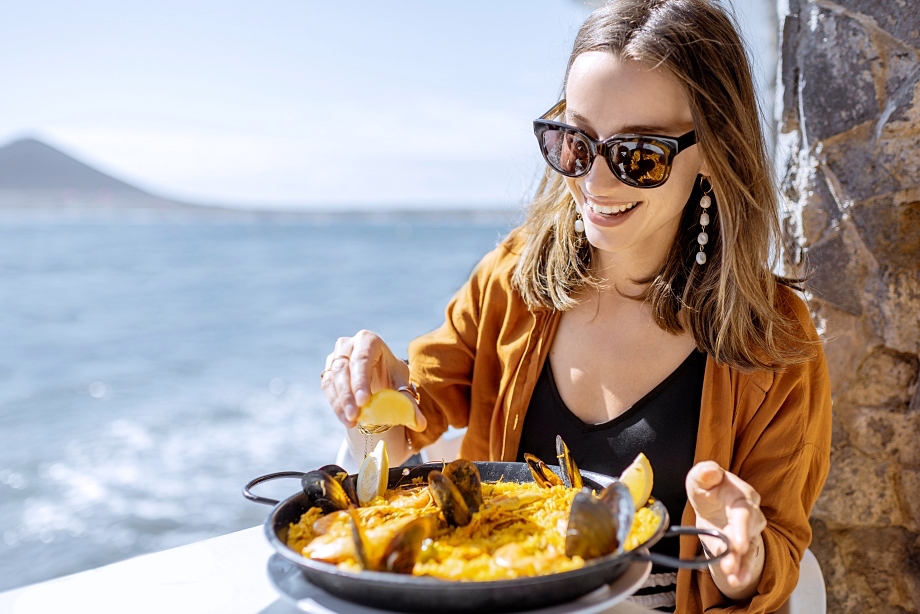
No visit to Spain would be complete without chowing down on a plate of piping hot paella. It’s Spain’s most famous dish and can also be served with seafood, rabbit or chicken. The rice and vegetables are seasoned with saffron, and the texture should be crispy. Try lots of different versions of paella during your stay. It never gets old!
Try different types of tapas
While the origins of this tasty tradition are hard to pin down, tapas is another Spanish culinary world superstar. A tapas dish is best described as an appetiser or snack, and you’ll generally find a selection of them on offer in bars and casual eateries. Sometimes they’re even included in the price of a drink. The portions are small and will enable you to try an array of typical local flavours.

Pork products such as cured ham (jamón), black pudding, and chorizo are trendy and popular tapas options. For non-meateaters, the tortilla is king. Made with fried potatoes and aioli or spicy sauce, it’s a delicious dish. Tapas can also include varieties of cheeses and olives.
Tapas dishes can come hot or cold (so ask which dish is which, if you have a preference).
Dive into the desserts
If you’re a definite sweet tooth, you’ll feel right at home in a traditional Spanish churreria (churro shop). A churro is a form of filled, fried dough, and can be either thick or thin; long or curled. The most popular filling is probably dulce de leche (sweet caramel). A churro can also be dipped in chocolate or sprinkled with cinnamon or sugar.

In cooler temperatures, a hot chocolate goes exceptionally well with a chocolate churro. Alternatively, if the weather is warm, opt for a cold leche merengada. It’s another classic Spanish dessert, and is made with milk, egg whites, sugar, and lemon zest. You’ll find it on offer in ice cream shops across the country.
Other popular desserts include flans, crema catalana (similar to a creme brulee), natilla de leche (custard tarts), and even apple pie! Try them all at least once.
How to order your meal in Spanish
There are some handy Spanish words and phrases to be familiar with when dining out. The first two you need to learn are ‘por favor’ and ‘gracias’; ‘please’ and ‘thank you’ respectively.
A single dish is ‘un plato’, and one serving is preceded by the article ‘un’ or ‘una’ (depending on whether the noun is feminine or masculine). If you want to ask for more than one dish, you can use the plural form: ‘unos’ or ‘unas’. So, to order one paella, you can say: ‘Un plato de paella, por favor’. As another example, ‘Una cerveza, por favor’ will see a single beer delivered to your table.
When it’s time for dessert and only a churro will do, say: ‘Un churro, por favor’. If you simply can’t stop at one, opt for: ‘Unos churros, por favor’.
To wrap the meal up, ask your waiter for ‘la cuenta’ (the bill). And always remember to depart with a ‘muchas gracias’.
Don’t be shy to give your newly learned lingo a go. The Spanish people are generally friendly and patient, and will be happy to help you along. It’s all part of the experience! Buen apetito!
Enrol at a Spanish language school in Barcelona
If you’re keen to take things a step further and have those food orders rolling off your tongue in Spanish, consider combining your holiday with an intensive language course. Expanish offers courses for tourists, students, and professionals who want to improve their language skills through immersion in Spain.
It doesn’t matter if you only know a few words to begin with. Before you enrol in your course, you’ll do a short online test to measure your existing knowledge. Based on the results, the teachers and staff at Expanish will recommend the perfect course for your needs.

Expanish’s Barcelona school is located in one of the city’s best areas, and there are facilities for learning, relaxing, and meeting new people. The teaching methodology is experience-based; students are encouraged to interact and use the language as much as possible. And class sizes are small, ensuring that the process is highly personalised.
One of the most popular elements of learning Spanish at Expanish is the array of free after-school activities, which mix tourism activities and language practice seamlessly. Enjoy a Spanish beer tasting or visit a relevant cultural space. You’ll get a taste of life as a local, while learning to speak the language at the same time.
This post was published thanks to Expanish.
Browse our range of Spain tours and experiences here.
Do you have any tips for the best dishes to try in Spain? We would love to hear from you. Please leave a comment below.
Additional images: Bigstock

About the writer
Adam Ford is editor of Top Oz Tours & Travel Ideas, and a travel TV presenter, writer, blogger, and photographer. He has travelled extensively through Europe, Asia, North America, Africa, and the Middle East. Adam worked as a travel consultant for a number of years with Flight Centre before taking up the opportunity to travel the world himself as host of the TV series Tour the World on Network Ten. He loves to experience everything a new destination has to offer and is equally at home in a five-star Palazzo in Pisa or a home-stay in Hanoi.